On the Third Day of Summer…

img_9135.jpgIMG_9443.JPGIMG_9384.JPG…my true love gave to me,

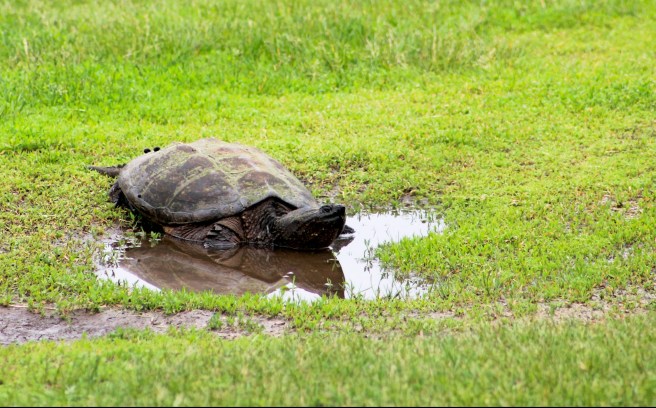
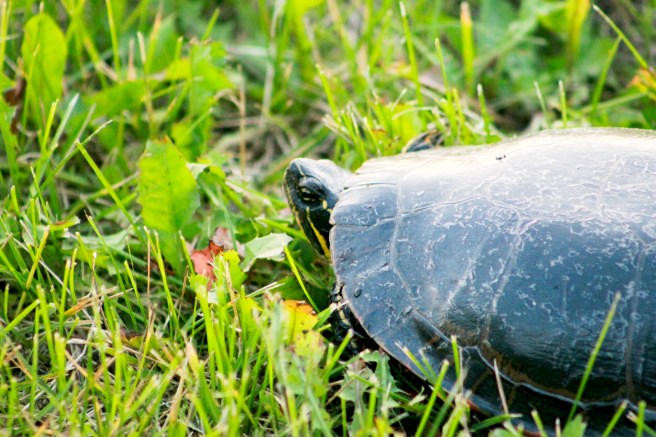
Three turtles crossing.

That first mama snapper?  She was big and black and dinosaur-like, but kind of boring.  She lumbered up into the yard one morning, checked out our puddles, bulldozed through my freshly-planted bed of onions, then lumbered back off to the lake, without so much as doing us the courtesy of letting us watch her lay eggs.

The second painted turtle was mostly rather cross about being herded out of the way for departing Wednesday night Bible study traffic.

I’d like you to notice, however, that I switched to the traditional line “true love” for today, because the little snapper in the third photo was, literally, given to me by my true love.  She was handed to me by my husband after being saved from certain doom on a busy highway, because I was in the passenger seat and he was not, and driving a vehicle while holding a snapping turtle is not necessarily recommended in the books.  In hindsight, I’m really not sure why we didn’t just switch places so I could drive while he held the turtle, but he says he thought it would be good for me to brush up on my turtle handling skills, and I suppose he was right.

This was after a failed experiment of containing the creature in the only container we could find in the car, a (breathable) shopping bag, from which she escaped and was temporarily lost under the driver’s seat.  If you’ve never had a snapping turtle loose in your vehicle, you are really missing out, by the way.  It’s very exciting, and you will discover what you always wanted to know, which is how nimble people actually are at tucking their feet up.  It will also leave all occupants vowing to always keep A Proper Turtle Container in the trunk for future such emergencies.

So there was nothing to do but hold her, and I took lots of one-handed photos while she intermittently fought my grip on her shell with her powerful webbed feet, and hung submissively, eyeing me closely.

“She either likes you or she doesn’t,” Zach observed helpfully.  Then, as if to settle the question, she stretched out her neck very long and arched it menacingly back toward my hand, and I raised my eyebrows and said firmly, “DOESN’T,” followed with some urgency by, “Are we there [at a safe turtle launching point] yet?!?!”

“Hold on,” he said encouragingly, “We’re almost there.”  This was true, and I must say that I was relieved to hand her over to his much more capable hands when we arrived. 

But seriously?  Encounters with wildlife, even when they’re just a tiny bit too close for comfort, are one big reason why I love these summer months, right along with the rest of my family.  Each creature, in all the glory of their splendid masterful design, armored shells, powerful beaks, elastic wrinkles, inquisitive intelligent eyes, brings praise to their Creator as they move and breathe and go on that annual search for the perfect place to lay some eggs.

If we can help them out a bit, and get close up looks in the process, we consider it an honor.

“My mouth will declare the praise of the LORD; let every creature bless His holy name forever and ever.” (Psalm 145:21)


Did you miss the others in this series?  This way to the first day and second day.

On the First Day of Summer…

IMG_9316.JPG…my searching brought to me,

A droplet on a lady slipper.

An alternate caption might read: “You know it’s really summer when…”Go take pictures of ladyslippers” makes the Top 3 on your to-do list for the day.”

As we all know, summer in Minnesota is furiously fast and fleeting.  Every year I vow to slow down and savor it better; every year, I promise you, it’s shorter.  But the faster it seems to go, the more determined I am to enjoy it, and so in that spirit, I’d like to announce the first in a series of a summery, illustrated version of “The 12 Days of Christmas”!  Stay tuned!

“So teach us to number our days, that we may apply our hearts unto wisdom.” (Psalm 90:12)


Harbinger

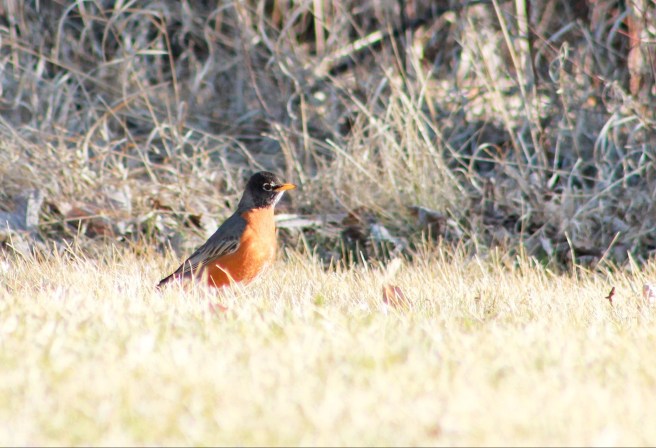
img_8262-e1525044489798.jpgI thought it was high time a robin put in an appearance, both in my yard and on this blog, but they took their sweet time this year.  I was hearing all sorts of sightings reported by friends and family, and I was seriously beginning to wonder if these little harbingers* of springtime were even going to show me their faces this year.  And if they didn’t, would it even really be spring?  I’m sure I don’t need to remind you that robins are about as quintessential to the advent of spring as pussy willows.
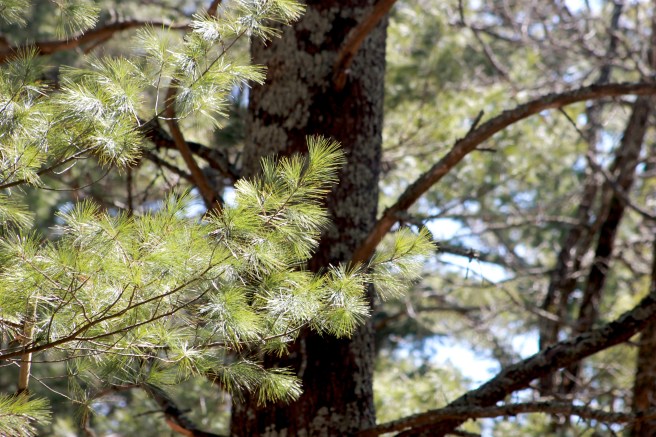
But, one bright morning this week, I heard a new yet familiar bird call through the window, and spotted a pair of handsomely erect rust-breasted worm-hunters running and hopping across the yard.  I melted a dark spot in the frosty grass sitting perfectly still until one (skeptically) got close enough for this shot.  So, just in case you needed reassurance, I thought I’d pass the news on to you that all is well, after all.  Spring really is here.

*Harbinger: “A person or thing that announces or signals the approach of another.”

How beautiful…are the feet of him who brings good news, who publishes peace, who brings good news of happiness, who publishes salvation, who says to Zion, “Your God reigns.” (Isaiah 52:7)

A Simple Recipe for Spring

IMG_8148.JPGStep 1: Bathe everything in a very generous amount of warm sunshine.IMG_8060-01Step 2: Wait for an awful lot of all this to melt.  Allow it to soak in thoroughly.IMG_8136.JPGStep 3: Enjoy the results, springing up from the sun-soaked, well-watered, nitrogen-infused happy earth.

“For as the rain and the snow come down from heaven,
            And do not return there without watering the earth
            And making it bear and sprout,
            And furnishing seed to the sower and bread to the eater;

So will My word be which goes forth from My mouth;
            It will not return to Me empty,
            Without accomplishing what I desire,
            And without succeeding in the matter for which I sent it.”

(Isaiah 55:10-11)

Cattail Glory

IMG_7553.JPGIn this season between seasons, when it’s not really winter but doesn’t really seem like spring either, the changes occurring in the natural world are sometimes very subtle.  Yet, I have learned, they are there.  Nothing is really sitting still.  Everything is silently, gradually, almost imperceptibly, readying itself for when it’s time to burst forth into newness of life.  It does require my camera and I to look harder on these days when a walk still requires me to wear the old winter hat and mittens, but the discoveries we do make of coming spring are only that much more triumphant.

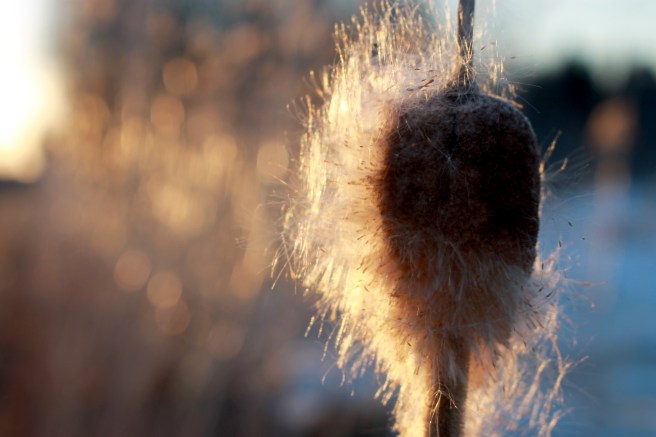
Today I take note: The last of the cattails that have been neat little brown cylindrical sausages on sticks all winter are finally, after months of wear by wind and snow, disintegrating into downy halos of seed.  They are dying, giving up of the very last of themselves.  Soon the bare stalks will turn soft as well, bowing to the swamp below them nevermore to rise again.

But we all know that somewhere, in other bare nooks in the swamp, baby cattails will spring forth from the downy fluff these tired old stalks are releasing to the wind.  There would be no continuance of life if they held onto the gift they possessed; it is only in the letting go that life will go on.  They release the old, looking forward unto the new and better things to come—and in the late afternoon sunshine, it’s as though they’re crowned with glory.

“But this one thing I do, forgetting those things which are behind, and reaching forth to those things which are before, I press toward the mark for the prize of the high calling of God in Christ Jesus. .”  (Philippians 3:13-14, KJV)

Muddy

IMG_7564.JPGIt’s the current miry state of the driveway.

I prefer it in the mornings like this, when it’s iced over and covered in interesting geometric designs.  Not only is it more photogenic, but my walking shoes prefer the feel of crunching to oozing and the state of being dry to damp.

My children, however, like it best after it’s sat in the sunshine for a while, all delightfully wet and squishy.  This would be why mud boots are an essential part of their spring wardrobes.  Not that I am so naive as to believe that mud boots will actually keep small children enjoying a mud puddle dry or clean—but I derive some comfort from the fact that at least their feet are.IMG_7641.JPGThe rest?  Nothing a good washing machine and bathtub can’t fix.  And that’s a good reminder to praise God for this even more remarkable truth:

“I will sprinkle clean water on you, and you will be clean; I will cleanse you from all your filthiness and from all your idols… (Ezekiel 36:25)

“I waited patiently for the Lord; he turned to me and heard my cry.  He lifted me out of the slimy pit, out of the mud and mire; he set my feet on a rock and gave me a firm place to stand. (Psalm 40:1-2)


Frosted

IMG_7147.JPGWhen I was a young, aspiring baker, my mother taught me how to frost cookies and cakes.  It’s an experience that I remember with striking clarity because, in her kitchen, not just any frosting job would do.  Frosting (the verb, not the noun) was not merely a job to get done.  It was an art form.
We started with the least fussy of surfaces, a simple 9×13 cake.  She taught me how to spread the frosting evenly, thick to the edges but not quite touching the sides of the pan, never letting your knife touch the actual cake.  If you did it right, there was this beautifully rounded smooth edge to the whole sweet mass.  Then, you went back over the whole thing and made rows of dips or swoops, evenly but quickly so it didn’t look like you tried too hard.  If you did that part right, it looked as effortless and beautiful as the wind-tossed waves of sun-kissed lake.  If you didn’t—well, let’s just say that’s what my first attempts looked like.

From there we graduated to different surfaces, different kinds of frosting.  Whipped cream allowed the greatest abandon of perfection, and was great fun—but one still had to fuss with it a bit, because it still needed to look artsy.  Meringue was where deeper dips were needed to create the desired peaks; extra points if those peaks curled at the tips.  Glaze required wrist flicking, and the artful contriving of “even” drips all around.

Shaped sugar cookies were the final test of my basic skills, and true sign that I was about to graduate.  The technique was just like a cake, only applied with the tippiest-tip of a butter knife, maintaining that smooth rounded edge all around varied curves that included the narrow length of gingerbread arms and complicated crystaled forms of snowflakes.  You never scraped you knife on the edge of a cookie.  That was what the edges of the frosting bowl were for.

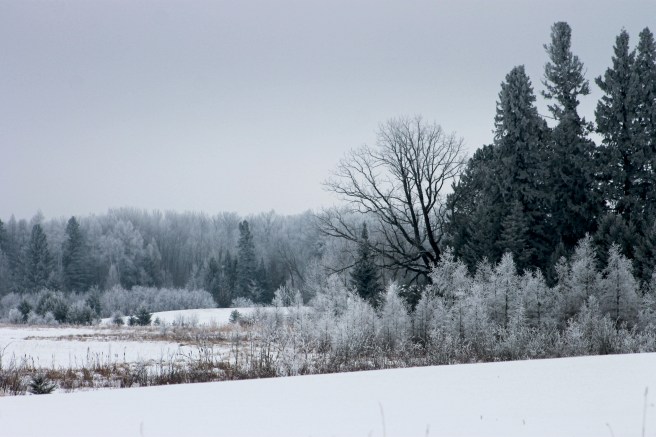
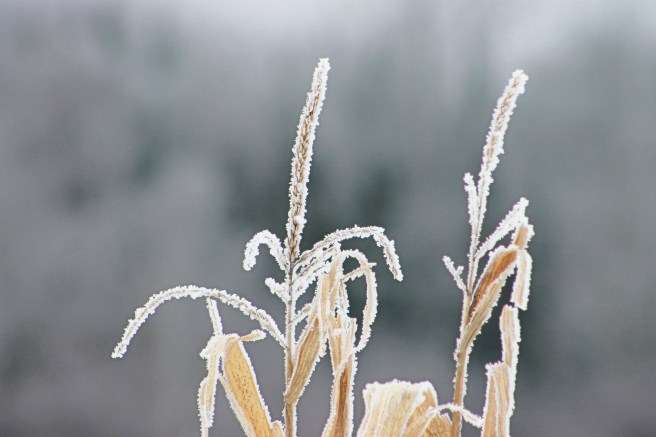
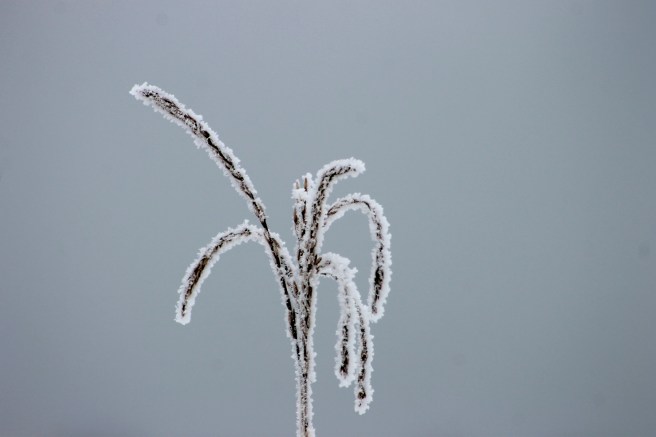
Once I’d mastered that, you’d think I’d arrived—but not so!  That’s when I started poring over her folder full of Wilton cake decorating books.  I’d hover around the table with my siblings, watching with fascination as my mom turned the sides of a layer cake into a woven basket and created three-dimensional roses on the end of a giant nail for our picture-perfect birthday cakes.  It was time to advance to a whole new level.IMG_7113.JPGIMG_7130IMG_7128IMG_7135IMG_7109.JPGOn mornings when I wake up to a frosted world, I can’t help thinking back to what it was like learning to frost.  I enjoyed learning, but mastering the techniques certainly didn’t happen overnight.  This refined coating of a thousand minute crystals deposited by a sudden drop in temperature, on the other hand, does.
I love how God makes something we have to work so hard to do right look so stunningly effortless.

“He gives snow like wool; He scatters the frost like ashes.” (Psalm 147:16)

An Ode to Resilience

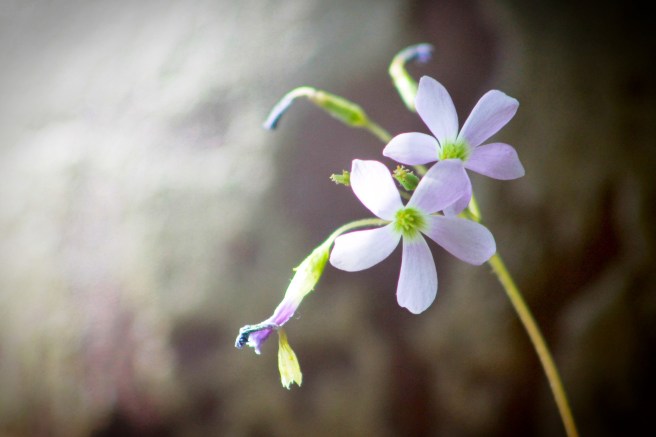
img_9657This is oxalis triangularis, otherwise known as purple shamrock.  It sits in my south window in the perfect spot to catch the full sun, positioned right where I can enjoy it whenever I’m sitting in my favorite chair nursing the wee babe, or less frequently, as I am this week, convalescing from illness.  I especially love the way the sunlight glows through the translucent lavender petals and maroon leaves, and the way those tri-lobed leaves go to bed every night when the sun goes down, folding up neatly into little origami points.

It’s my very favorite houseplant—but nice as all these things are, it might surprise you to know that it’s really an entirely different quality than these that elevated it to the top of the list.

What this photo doesn’t tell you is that last week, this favorite plant of mine had an accident.  We won’t name any names, but lets just say that having houseplants in the same house as toddlers is a rather optimistic idea.  Also, this is why I don’t (or shouldn’t) ever buy expensive flower pots.  Furthermore, it’s the third accident it’s had of this sort, not to mention multiple other instances of small hands plucking off way too many leaves and stems, because apparently I’m not the only one who thinks it’s pretty.

It’s not what I would call a sturdy plant by looking at it.  The leaves are tender and the stems easily broken, and every accident has literally crushed it.  Every time I’ve tucked it into a new pot when the former has been broken, or given it an extra drink after an inopportune childish pruning, I’ve thought that surely this was it.  Surely, the oxalis was going to succumb to adversity this time around.  I’ve had other houseplants that have given up the ghost under far less trying circumstances.

And, for a few days, it generally supports my fear.  All the remaining foliage dies.  By all appearances, it is time to dump the pot and move on with life.  But, always, just when I’ve given up on it, the coil of a tiny translucent shoot appears, tipped in the deep purple of the tiniest of exquisite new leaves—and the oxalis lives on yet again.

This seemed quite miraculous to me until I learned that the key to the strength of the oxalis is not in it’s stems, leaves or flowers, or even it’s roots.  It’s strength is actually in tiny tuberous bulbs, which are the true, hidden heart of the plant.

This then is the quality that has elevated this little houseplant to the top of my list of favorites.  A gorgeous little plant that obligingly flowers year round and can bounce back after any manner of toddler encounters?  This may very well be perfection in a pot.

There are quite a few lessons here, but perhaps the most important is that a person’s ability to handle hard times with resilience stems directly from where they are drawing their strength in all of the other times.  And the people who I have watched face trying times, who get back up time after time, with wounded souls shining strong, beautiful and tender yet again, always have one thing in common: their day-to-day lives have been centered in Christ.  There’s a difference, you see, between rising from adversity with a shell of hardened bitterness or cynicism, and that of rising from adversity with a renewed growth in faith, gentleness and hope.  Only a heart deeply rooted in Jesus can do that.

Abide in me, and I in you. As the branch cannot bear fruit by itself, unless it abides in the vine, neither can you, unless you abide in me. I am the vine; you are the branches. Whoever abides in me and I in him, he it is that bears much fruit, for apart from me you can do nothing.” (John 15:4-5)

“He gives power to the faint, and to him who has no might he increases strength.” (Isaiah 40:29)

“I can do all things through Christ who strengthens me.” (Philippians 4:13)

“My help comes from the Lord, who made heaven and earth.” (Psalm 121:2)

To view a fun time lapse video of oxalis leaves “going to sleep”, go here.


Porcupine

img_6749.jpgOh, to be a porcupine up in a tree,

a conspicuous ball of black against the blue,

placidly nibbling tree buds,

oblivious to the -25 wind chill,

whose only response to a curious passerby ankle deep in snow

(after that twinkling in his eye—or was I imagining that?)

is to curl up into a slightly tighter ball,

just to be sure I didn’t forget that he had nothing to be afraid of underneath all that spiky armor.

IMG_6744.JPGBut I suppose that since I can’t be a porcupine

I can be a city on a hill instead, or maybe a lamp on a stand—or maybe both at once, since they have so much in common.

Especially the way a city glows after dark,

conspicuous for miles around in it’s reflections up to the heavens,

placidly humming with all the activity that makes it a city,

stoplights constantly switching colors,

brake lights flashing and turn signals blinking,

people closing the blinds at night so they can sleep in spite of the constant glow of lampposts.

Cities, like porcupines, don’t really know who might be wearily traveling

down long highways way off in the darkness,

gazing at the lights,

moving towards them and their promise of things to eat and places to lay their heads—

but they shine on steady through the night anyway.

You are the light of the world. A city set on a hill cannot be hidden. Nor do people light a lamp and put it under a basket, but on a stand, and it gives light to all in the house. In the same way, let your light shine before others, so that they may see your good works and give glory to your Father who is in heaven.” (Matthew 5:14-16)

Frost Fire

IMG_6324.JPGThere’s a new year rising, about ready to break over the horizon just like the sun was on this breathtakingly frosty morn.

What will it hold?

Naturally, not one of us can predict exactly.  We can talk, dream of and discuss plans, goals and resolutions until the clock strikes midnight—but no one really knows what will happen.  This we do know, however:

“Commit your work to the LORD, and your plans will be established.” (Proverbs 16:3)

Because of that, just as the hoary treetops turned to fire, aflame with the hope and oncoming glory of the new day, this new year can be bright with hope on your horizon, too.  No matter what it holds, if we acknowledge Him each step of the way—be it exciting, ordinary or difficult—He will make our path straight.  Cling to that!